Crystal Clarity
Complex wisdom distilled into actionable insights. No fluff—just practical understanding you can use today.
Understand and apply the wisdom in daily life — for both beginners and seekers.
• For people who read Autobiography of a Yogi and want deeper clarity
• For beginners who want the teachings explained in modern language and practical steps
Inspired by the book, but unsure how to apply it?
Did the stories feel profound, yet hard to understand?
Finished reading, but don't know what to do next?
This is not a summary. This is not surface-level spirituality. This is a guided, structured system designed to help you understand the teachings chapter by chapter — and integrate them into your daily life with clarity and practical application.
Practical skills and clear insights you can apply immediately to bring structure and understanding to your daily life.
Complex wisdom distilled into actionable insights. No fluff—just practical understanding you can use today.
Build habits that actually stick using proven frameworks for lasting, meaningful change.
Observe your thoughts and master your responses. Stop reacting—start responding with intention.
Navigate life's challenges with clarity and steady focus. Build the stability to respond thoughtfully, not react.
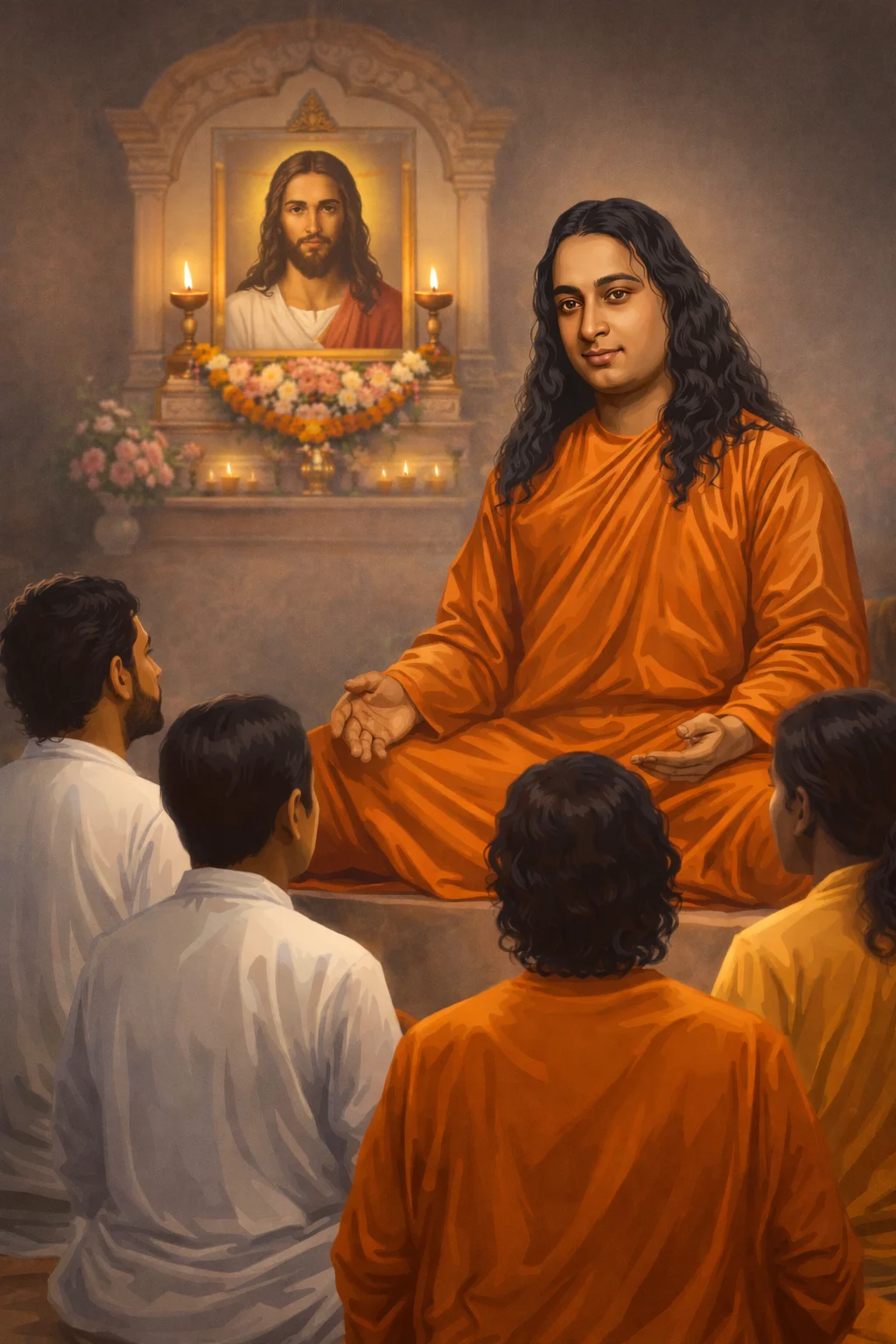
Paramahansa Yogananda (1893–1952) transformed Western understanding of Eastern wisdom. His teachings on self-mastery, discipline, and awareness have guided millions toward personal transformation and peak performance.
His book "Autobiography of a Yogi" has sold millions of copies worldwide and was the only book Steve Jobs had on his iPad—read once every year.
Born Mukunda Lal Ghosh in Gorakhpur, India, Yogananda showed profound spiritual inclinations from earliest childhood. His life journey took him from the sacred banks of the Ganges to the stages of America, transforming millions along the way.
Yogananda lectured to capacity crowds across America for over 30 years. His teachings influenced figures from George Harrison to Steve Jobs, making Eastern wisdom accessible to Western minds.
Yogananda taught that lasting happiness comes from within through scientific techniques of concentration and meditation. His approach emphasizes direct experience over blind belief.
In an age of distraction and anxiety, Yogananda's practical methods for developing focus, discipline, and inner peace are more relevant than ever.
Paramahansa Yogananda's teachings were preserved primarily through his books, lectures, and recorded talks. Unlike many spiritual teachers whose wisdom was passed down orally, Yogananda took great care to document his knowledge in written form so it could be studied, practiced, and verified by future generations.
His books are not meant to be read casually or rushed through. Each work is layered—combining philosophy, psychology, meditation science, devotional insight, and direct spiritual instruction. Many readers report discovering new meanings each time they revisit the same passages, even years later.
From his spiritual classic Autobiography of a Yogi to his profound commentaries on the Bhagavad Gita and the teachings of Jesus Christ, Yogananda's writings serve different purposes: awakening curiosity about spiritual truth, explaining universal laws of consciousness, providing practical meditation guidance, reconciling science and religion, and offering lifelong spiritual study material.
The spiritual classic that has transformed millions of lives worldwide.
Yogananda's first book establishing religion as verifiable science.
Monumental two-volume commentary on the Bhagavad Gita.
Revolutionary interpretation revealing Jesus as a master yogi.
First volume of collected talks on vast spiritual topics.
Collected talks on love, devotion, and divine relationship.
Third volume focusing on practical steps of the inner journey.
Devotional prayers, affirmations, and mystical poetry.
Over 300 meditations for health, success, and awakening.
The science of mental and spiritual healing techniques.
Practical guidance on establishing divine communion.
Thematically organized guidance on life's essential questions.
Gems of wisdom distilled into memorable statements.
Spiritual principles underlying achievement in any field.
Core principles for cultivating lasting inner joy.
Techniques for mental tranquility in a turbulent world.
Universal laws governing the soul's journey.
The yogic teachings hidden in Jesus's words.
Accessible introduction to the Gita's essential teachings.
From his earliest years, Mukunda Lal Ghosh displayed an extraordinary sensitivity to spiritual matters. Born on January 5, 1893, in Gorakhpur, India, he was the fourth of eight children in a devout Bengali family. His father, Bhagabati Charan Ghosh, was a senior executive with the Bengal-Nagpur Railway and a disciple of Lahiri Mahasaya, the great master who revived the ancient science of Kriya Yoga.
Young Mukunda's childhood was marked by profound spiritual experiences that set him apart from other children. He often fell into deep states of meditative absorption, sometimes remaining motionless for hours. His mother, Gyana Prabha, recognized these tendencies and nurtured his spiritual development, telling him stories of saints and sages that fired his imagination.
"Even in my earliest memories, I was convinced that I had come into this world with a specific mission to fulfill. The ordinary ambitions that drove my schoolmates held no attraction for me."
At the age of eleven, Mukunda experienced a profound spiritual awakening following his mother's death. This event intensified his longing for God-realization and set him on an unwavering quest to find his guru—the spiritual teacher who would guide him to enlightenment.
The meeting that would define Yogananda's life occurred in 1910, when the seventeen-year-old Mukunda encountered Sri Yukteswar Giri in the holy city of Benares. The moment was electric with spiritual significance—both master and disciple recognized each other instantly from past incarnations.
Sri Yukteswar was no ordinary teacher. A direct disciple of Lahiri Mahasaya and a master of both Eastern mysticism and Western scientific thought, he possessed the rare ability to present ancient truths in modern, rational terms. This quality would profoundly shape Yogananda's own teaching style.
Upon their first meeting, Sri Yukteswar said to Mukunda: "I have been expecting you. You have come to me at last, after many incarnations of seeking. I will be your guru."
For the next ten years, Mukunda lived as Sri Yukteswar's disciple at his ashram in Serampore. The training was rigorous—not just in meditation techniques, but in every aspect of character development. Sri Yukteswar demanded precision, punctuality, and absolute honesty from his students.
Life at Sri Yukteswar's ashram was a crucible of transformation. The master employed unconventional methods to break down the ego and build spiritual strength. He might praise a student one moment and deliver crushing criticism the next, always with the purpose of eliminating attachment to praise and blame.
During these formative years, Mukunda mastered the ancient science of Kriya Yoga—a powerful meditation technique that accelerates spiritual evolution. He also received training in the Vedas, the Upanishads, the Bhagavad Gita, and the Bible, developing the interfaith understanding that would characterize his later teachings.
In 1915, Mukunda took formal monastic vows and received the name "Yogananda," meaning "bliss through divine union." He graduated from Calcutta University the same year with a Bachelor of Arts degree, demonstrating his master's insistence on balanced development.
The vision came clearly: Yogananda was to bring India's ancient wisdom to America. In 1920, as a delegate to the International Congress of Religious Liberals in Boston, the twenty-seven-year-old swami set sail for the United States, carrying little more than a few dollars and an unshakeable conviction in his mission.
His first years in America were challenging. He knew almost no one, spoke English with difficulty, and faced the cultural prejudices of the era. Yet his sincerity and the power of his message soon began attracting students. His lectures drew increasingly large crowds, and by 1925, he had established his headquarters at Mount Washington in Los Angeles.
Over the next three decades, Yogananda would crisscross America, delivering over 100 lectures per year to audiences often numbering in the thousands. He met with presidents, scientists, and business leaders. He initiated thousands of students into Kriya Yoga. And in 1946, he published his masterwork, "Autobiography of a Yogi," which would eventually be translated into over 50 languages and sell millions of copies worldwide.
"The West has need of the spiritual idealism of the East, while the East needs the material efficiency of the West. This exchange will be beneficial to both."
Paramahansa Yogananda's arrival in America in 1920 marked a watershed moment in the spiritual history of the West. While a handful of Indian teachers had visited before, none had stayed to establish permanent institutions or train Western disciples in authentic yogic practices.
Yogananda fundamentally changed how the West understood meditation. Before his work, most Westerners associated yoga primarily with physical postures or viewed meditation as an exotic curiosity. Yogananda presented meditation as a precise science—a systematic method for achieving specific results in consciousness.
Yogananda was the first great master of India to live in the West for an extended period (32 years), establishing deep roots and training teachers who could carry on after him.
His approach was revolutionary in several ways. He stripped away cultural baggage that might alienate Western students while preserving the essential techniques. He drew parallels between yoga philosophy and Christian mysticism, showing that all religions point toward the same truths. And he insisted that spirituality must be practical—that genuine practice should produce tangible improvements in daily life.
The reach of Yogananda's influence extended to some of the most influential figures of the 20th and 21st centuries:
Beyond celebrities, Yogananda influenced countless scientists, artists, business leaders, and ordinary seekers who found in his teachings a practical path to inner peace and self-realization.
The organization Yogananda founded, Self-Realization Fellowship (SRF), continues to thrive more than seven decades after his passing. With headquarters still at Mount Washington in Los Angeles, SRF maintains:
Yogananda also established Yogoda Satsanga Society of India, which operates numerous ashrams, schools, and charitable programs throughout the Indian subcontinent.
"The time for knowing God has come. The age of miracles is not past. The timeless laws of science and spirituality shall be demonstrated anew."
His book "Autobiography of a Yogi" has never been out of print since its publication in 1946. It has been named one of the 100 most important spiritual books of the 20th century and continues to introduce new generations to the possibilities of inner transformation.
At the heart of Yogananda's message lies the concept of Self-realization—the direct, personal experience of one's true nature as divine consciousness. This is not mere intellectual understanding or blind belief, but actual experience achieved through systematic practice.
According to Yogananda, every human being is essentially a soul—a spark of infinite consciousness temporarily identified with a body and mind. This misidentification is the root cause of all suffering. Self-realization is the process of awakening from this illusion and recognizing our true, unlimited nature.
"Self-realization is the knowing—in body, mind, and soul—that we are one with the omnipresence of God; that we do not have to pray that it come to us, that we are not merely near it at all times, but that God's omnipresence is our omnipresence."
This realization isn't reserved for monks or saints. Yogananda repeatedly emphasized that anyone—regardless of religion, background, or lifestyle—can achieve it through proper practice. The path is open to all who sincerely seek it.
Yogananda approached meditation not as a vague spiritual exercise but as a precise science with predictable results. Just as chemistry follows fixed laws, so too does the science of consciousness. Apply the correct techniques consistently, and specific results follow inevitably.
The cornerstone of his teaching is Kriya Yoga, an advanced meditation technique that works directly with life force (prana) and the subtle energy centers (chakras) of the spine. Kriya Yoga accelerates spiritual evolution by:
Yogananda taught that one Kriya, practiced correctly, is equivalent to one year of natural spiritual evolution. This claim may seem extraordinary, but countless practitioners over the decades have reported dramatic acceleration in their inner development.
Beyond Kriya, Yogananda taught a complete system including:
Yogananda never advocated withdrawal from the world. He taught that true spirituality must be lived in the marketplace, in relationships, in work, and in all aspects of daily existence. The goal is not to escape life but to infuse it with higher awareness.
Key practical applications include:
"Be calmly active and actively calm. That is the way of the yogi."
Yogananda's teachings address every aspect of life—health, relationships, success, creativity, and ultimate spiritual fulfillment. They offer not a philosophy to believe but a science to practice, with results that can be verified by anyone willing to make the effort.
Yogananda Teachings presents Yogananda's wisdom as an educational resource, independent of any religious organization. Our approach differs from traditional spiritual institutions in several important ways:
We believe Yogananda's teachings belong to humanity, not to any single organization. Our mission is to make them accessible to modern seekers in a format that respects their intelligence and autonomy.
The challenges Yogananda addressed have only intensified in the 21st century. Consider the modern epidemic of distraction: the average person checks their phone 150 times per day. Our attention spans have shrunk to mere seconds. We're more connected than ever yet lonelier than ever.
Yogananda's teachings address these modern afflictions directly:
Research increasingly validates what Yogananda taught a century ago. Studies on meditation show it physically changes the brain, reducing activity in the amygdala (the fear center) and strengthening the prefrontal cortex (responsible for executive function). It reduces inflammation, lowers blood pressure, and improves immune function.
Modern practitioners apply Yogananda's teachings across every area of life:
In Business: Entrepreneurs use concentration techniques to enhance creativity and decision-making. The ability to remain calm under pressure—a skill meditation develops—proves invaluable in high-stakes negotiations and leadership roles.
In Relationships: The self-awareness developed through practice helps people respond rather than react. Understanding our own mental patterns allows us to communicate more effectively and build deeper connections.
In Health: The stress-reduction benefits alone make meditation one of the most powerful health interventions available. Combined with the energization exercises and lifestyle principles Yogananda taught, practitioners report dramatic improvements in vitality and well-being.
In Creativity: Artists, writers, and innovators find that regular meditation opens access to deeper levels of inspiration. The still mind becomes a clear channel for creative ideas to flow.
"In the midst of activity, you should find a stillness of mind that remains unruffled. That is the consciousness with which you should live."
What Yogananda offered was not escape from life but a way to live more fully, more consciously, more effectively. His teachings remain a practical roadmap for anyone seeking to transform their experience of being human—not in some distant future, but starting today.
Autobiography of a Yogi stands as one of the most influential spiritual books of the 20th century—a gateway text that has introduced millions to the science of meditation, the reality of spiritual masters, and the unity underlying all religious teachings. Since its publication in 1946, it has been translated into over fifty languages and has never gone out of print, continuing to transform lives more than seven decades after Yogananda first set pen to paper.
This spiritual memoir chronicles Yogananda's extraordinary journey from his childhood in India through his training under the great master Sri Yukteswar Giri, and ultimately to his mission of bringing yoga and meditation to the West. But it is far more than autobiography—it is a guided tour through the hidden spiritual dimensions of existence, written by one who had directly experienced the realities he describes.
The book introduces readers to an astonishing array of saints, yogis, and miracle workers whom Yogananda encountered throughout his life. From the levitating saint Nagendra Nath Bhaduri to the fragrance-emanating Gandha Baba, from the sleepless saint Ram Gopal Muzumdar to encounters with the legendary Babaji—each chapter reveals aspects of consciousness and spiritual law that challenge conventional materialist assumptions about what is possible.
Yet the book's enduring power lies not in its accounts of miracles, but in its clear explanation of the science behind spiritual development. Yogananda demystifies concepts like karma, reincarnation, cosmic consciousness, and the subtle energy centers (chakras) without requiring readers to accept anything on blind faith. He presents spiritual truths as verifiable through direct experience—the same approach used in scientific inquiry.
Steve Jobs famously kept it as the only book on his iPad, reading it once every year. George Harrison of the Beatles credited it with transforming his understanding of life and death. Countless scientists, artists, and entrepreneurs have cited it as a pivotal influence on their worldview.
Key themes woven throughout include: the underlying unity of all religions and their shared mystical core; meditation as an exact science with predictable, reproducible results; the existence of a living lineage of enlightened masters guiding humanity's evolution; the nature of the guru-disciple relationship as the foundation of spiritual transmission; karma and reincarnation as natural laws governing soul evolution; and the possibility of direct Divine communion available to all sincere seekers.
For those new to Yogananda's teachings, Autobiography of a Yogi is the essential starting point—a doorway into a vast landscape of wisdom that can be explored for a lifetime.
The Science of Religion was Yogananda's first book, written in 1920 before his journey to America. Despite its early composition, it contains the philosophical foundation upon which all his later teachings rest—a systematic argument that true religion must be based on direct experience rather than belief, and that spiritual truths can be verified through scientific methodology.
The central premise is revolutionary yet simple: if religious claims are true, they must be demonstrable. Just as physics describes laws governing matter and energy, authentic spirituality describes laws governing consciousness and inner experience. The ancient yogis were essentially scientists of the inner world, conducting careful experiments in awareness and documenting their findings with precision.
Yogananda argues that all human beings, regardless of religious background, are seeking the same thing—lasting happiness and freedom from suffering. He traces this universal drive to its source in the nature of consciousness itself, showing that what we truly seek is not temporary pleasure but permanent bliss, our original nature obscured by ignorance and mental turbulence.
The book introduces meditation not as mystical ritual but as repeatable experiment. When the mind is stilled through specific techniques, certain invariable results follow—just as heating water to 100°C inevitably produces steam. These results include expanded awareness, inner peace, intuitive insight, and ultimately direct perception of the Divine Presence underlying all creation.
Key concepts explored include: consciousness as the fundamental reality underlying all phenomena; the nervous system as a finely tuned instrument for spiritual perception; breath control (pranayama) as a means of regulating life force and stilling mental fluctuations; the distinction between intellectual understanding and direct experiential knowledge; the universal validity of spiritual laws across all religious traditions.
This book is particularly valuable for readers with analytical or skeptical mindsets who appreciate logical argumentation and evidence-based approaches. Rather than asking readers to believe, Yogananda invites them to experiment and verify for themselves—the hallmark of genuine scientific inquiry applied to the realm of spirit.
God Talks With Arjuna represents Yogananda's monumental two-volume commentary on the Bhagavad Gita—India's most revered scripture. Spanning over 1,600 pages, this work reveals the Gita not as ancient mythology but as a practical manual for spiritual transformation, encoded in symbolic language that speaks directly to the challenges every seeker faces.
The Bhagavad Gita's setting—a battlefield where the warrior Arjuna faces his own relatives in combat—is interpreted by Yogananda as representing the inner war each person must wage. The battlefield of Kurukshetra symbolizes the field of the body and mind where spiritual forces (the Pandavas) battle material tendencies (the Kauravas) for control of consciousness.
Arjuna represents the devotee or sincere seeker, initially confused and overwhelmed by the difficulty of spiritual life. His charioteer Krishna represents the Divine Guru, the God-consciousness that guides the soul toward liberation. Their dialogue—which comprises the entire Gita—becomes a template for the relationship between the human soul and its Divine Source.
Yogananda's interpretation differs from conventional readings by revealing the yogic science encoded within each verse. References to weapons, armies, and warriors are decoded as representing specific mental faculties, energy centers, and spiritual practices. The result is a text that speaks with startling directness to the inner life of the practitioner.
Central themes include: the nature of the soul (atman) as distinct from body and mind; the three gunas (qualities of nature) and their influence on consciousness; karma yoga as action without attachment to results; bhakti yoga as the path of devotion; jnana yoga as the path of wisdom and discrimination; dhyana yoga as the path of meditation; and practical guidance for self-discipline and ethical living.
This work is for serious students ready to engage deeply with spiritual practice. It rewards repeated study over years, revealing new dimensions as the reader's own understanding deepens through practice.
The Second Coming of Christ: The Resurrection of the Christ Within You is Yogananda's revolutionary two-volume interpretation of the Gospels—revealing Jesus as a fully realized yogi whose teachings contain the same universal science of God-realization found in India's ancient traditions.
The title itself conveys the book's central message: the "Second Coming" is not a future external event but an inner awakening available to every soul. Christ Consciousness—the universal divine presence that manifested through Jesus—can be resurrected within any individual who applies the scientific methods of meditation and spiritual discipline.
Yogananda brings to the Gospels the lens of a master meditator, revealing metaphysical meanings hidden beneath the literal surface. Jesus's miracles are explained not as supernatural violations of natural law, but as demonstrations of higher laws governing consciousness and matter. His parables are decoded as precise instructions for spiritual practice.
The Lord's Prayer becomes a comprehensive meditation technique. The Beatitudes describe progressive stages of spiritual awakening. Jesus's statement "I and my Father are one" describes the state of cosmic consciousness attainable through deep meditation.
The book presents Jesus not as the exclusive possession of any religion, but as belonging to all humanity—a wayshower who demonstrated the potential inherent in every soul. Yogananda shows the harmony between Jesus's teachings and those of Krishna, Buddha, and the great masters of all traditions.
Key themes explored include: Christ Consciousness as a universal state of awareness; the true meaning of baptism, resurrection, and salvation; the Holy Ghost as the intelligent cosmic vibration (Aum/Amen); techniques for awakening the spiritual eye; and the essential unity of Christianity's mystical core with the perennial wisdom of all traditions.
Man's Eternal Quest is the first volume of Paramahansa Yogananda's collected talks and essays, containing over fifty lectures delivered during his thirty years of teaching in America. These talks preserve the spontaneous wisdom and magnetic presence that drew thousands to his public lectures and private gatherings.
Unlike his systematic scriptural commentaries, these collected talks have an immediacy and directness that make them accessible entry points into Yogananda's teachings. The conversational tone captures his ability to address profound truths in language anyone could understand, often illuminated by humor, personal anecdotes, and practical examples.
Topics range from practical guidance on health, diet, and relationships to profound expositions on the nature of God, the afterlife, and cosmic creation. The book addresses humanity's deepest questions with characteristic clarity: Why are we here? What happens after death? How can we find lasting happiness? How do we overcome negative habits and develop willpower?
Key sections cover meditation techniques and their physiological effects, the science of healing through mind power and life force, developing concentration and memory, overcoming fear and worry through spiritual understanding, understanding dreams and the astral world, the spiritual significance of diet and health practices, and the role of will and divine grace in achieving liberation.
Yogananda's approach throughout is intensely practical. He rarely discusses spiritual principles without showing how they apply to daily challenges. Whether addressing financial difficulties, relationship problems, health issues, or existential questions, he brings the light of yogic wisdom to bear on real human concerns.
This volume serves as an excellent introduction for newcomers while offering longtime students fresh perspectives on familiar teachings.
The Divine Romance is the second volume of Paramahansa Yogananda's collected talks, focusing on themes of love, devotion, and the soul's intimate relationship with the Divine. The title reflects Yogananda's central insight: that the deepest love humans seek in earthly relationships is actually the soul's yearning for union with God.
These talks explore how human love—romantic, familial, and friendship—can be spiritualized and directed toward its ultimate Source. Yogananda addresses the challenges and possibilities of relationships with remarkable psychological insight, showing how attachment can be transformed into divine love that liberates rather than binds.
The book examines why human relationships often disappoint despite our best efforts. Yogananda explains that we are seeking infinite love from finite beings—an impossible demand that inevitably leads to frustration. The solution is not to abandon human love but to recognize its source and learn to channel it appropriately.
Topics include the nature of true love versus attachment, finding God in daily life and ordinary activities, the spiritual meaning of soulmates and twin souls, overcoming loneliness through inner communion with the Divine, developing unconditional love that expects nothing in return, and the path of bhakti yoga (devotion) as a direct route to God-realization.
Yogananda's treatment of devotion is neither sentimental nor abstract. He presents specific practices for cultivating divine love: how to pray effectively, how to feel God's presence, how to transform emotional energy into spiritual aspiration. The talks reveal a master who lived what he taught—whose own love for God was so palpable that it awakened similar feelings in those around him.
For those drawn to the heart's path to God, this volume offers both inspiration and practical guidance.
Journey to Self-Realization is the third volume of Paramahansa Yogananda's collected talks, continuing the exploration of spiritual themes with particular emphasis on the practical steps of the inner journey. These talks serve as guideposts for seekers at every stage of development, from beginners taking their first steps to advanced practitioners facing subtler challenges.
The volume addresses how to make steady spiritual progress in a world full of distractions and obstacles. Yogananda shares insights from his own journey and from the lives of the masters he encountered, offering both encouragement and realistic assessment of what the path requires.
Topics include awakening and maintaining spiritual hunger—the essential motivation without which progress is impossible; the role of the guru in accelerating spiritual evolution and how to recognize genuine teachers; proper practice of meditation including common mistakes and how to avoid them; developing intuition as a faculty of direct knowing beyond intellect; overcoming karma through understanding and right action.
The book also explores deeper metaphysical territories: understanding the astral and causal worlds that await us after physical death; the nature of the soul's journey through multiple incarnations; how enlightened masters maintain contact with their disciples even after leaving the physical body; and preparing for the ultimate transition of death with consciousness and grace.
Yogananda's approach balances high idealism with practical wisdom. He never minimizes the challenges of spiritual life, yet consistently points to the rewards that await sincere effort. His words carry the authority of one who has walked the entire path and returned to guide others.
This volume is particularly valuable for those who have established a regular practice and seek to deepen it.
Whispers from Eternity is Paramahansa Yogananda's collection of devotional prayers, affirmations, and mystical poetry. These writings emerged from his own meditation experiences and express the soul's intimate dialogue with the Divine in language of extraordinary beauty and power.
The book is designed not merely to be read but to be used—each prayer and meditation serving as a doorway into deeper communion. Yogananda called these writings "spiritualized demands" that help attune the consciousness to receive divine grace. Unlike ordinary prayers of petition, they are structured to transform the one who prays.
The collection spans the full range of spiritual aspiration. Some prayers are tender and intimate, expressing the soul's longing for its Beloved with the passion of mystical poetry. Others are cosmic in scope, addressing the Infinite as the power behind all creation. Still others focus on specific needs: healing, guidance, protection, prosperity, peace.
Yogananda's approach to prayer differs from conventional religious practice. He teaches that prayer should not be begging but communion—a confident assertion of our unity with the Divine Source. The affirmations in this book are constructed to reprogram the subconscious mind, replacing doubt with faith and weakness with strength.
Key sections address prayers for healing of body, mind, and soul; prayers for guidance in decision-making and life direction; prayers for inner peace and freedom from anxiety; prayers for spiritual awakening and direct experience of God; and prayers for protection and divine grace in all circumstances.
For practitioners, these writings become companions in the inner life. Many readers find that a single prayer, used repeatedly over time, opens dimensions of consciousness they never knew existed.
Metaphysical Meditations provides over 300 meditations and affirmations for developing different aspects of consciousness. This practical manual covers meditations for health, success, wisdom, happiness, spiritual awakening, and direct experience of the Divine Presence.
The book is organized to address every dimension of human need and aspiration. Physical health receives attention through meditations that direct life force to healing. Mental clarity is developed through concentration exercises. Emotional balance is cultivated through affirmations that reprogram reactive patterns. Spiritual awakening is supported through meditations that open awareness to higher realities.
Yogananda taught that affirmations—when charged with concentration, devotion, and will—have the power to transform the subconscious mind and attract corresponding realities. This is not mere positive thinking but a precise science of consciousness. The affirmations in this book are structured according to principles Yogananda learned from his guru and refined through decades of practice.
Each meditation is designed to be practiced repeatedly until its truth becomes internalized. The approach is systematic: begin with physical relaxation, then calm the breath and mind, then focus attention on the affirmation until it penetrates beyond intellectual understanding to become living reality.
Key sections include meditations for physical healing and vitality, meditations for mental power and clarity, meditations for success and prosperity, meditations for overcoming negative emotions, meditations for developing intuition, meditations for experiencing the presence of God, and meditations for specific life situations and challenges.
The book serves as a comprehensive toolkit for spiritual practice, providing meditations for virtually every situation the seeker may encounter on the path.
Scientific Healing Affirmations explains the science behind mental and spiritual healing and provides specific techniques for using thought, will, and life force to overcome physical, mental, and spiritual disease. Yogananda presents healing as a science with precise methods and predictable results.
The book begins with a thorough explanation of the relationship between mind and body. Yogananda shows how consciousness influences physical health through the nervous system and life force (prana). Disease often originates in mental and emotional disturbances that disrupt the flow of vital energy; true healing must address these root causes.
The healing methods presented range from simple affirmations to advanced techniques involving visualization and energy direction. Yogananda distinguishes between different levels of healing: physical methods that treat symptoms, mental methods that address psychological causes, and spiritual methods that invoke divine healing power.
Affirmations are provided for various conditions, along with detailed instructions for proper practice. The key is not merely repeating words but engaging the full power of concentration, will, and faith. Yogananda describes the physiological mechanisms by which thought influences body chemistry and cellular function.
The book also addresses how to help others heal, including techniques for transmitting healing energy and the proper mental attitude for one who would serve as a healing channel. Yogananda warns against spiritual ego and emphasizes that all healing ultimately comes from the Divine Source.
Importantly, Yogananda emphasizes that spiritual healing works in harmony with, not opposition to, medical treatment. The mind's healing power is presented as a complement to physical remedies, not a replacement for proper medical care.
How You Can Talk with God addresses the universal longing for direct contact with the Divine. Yogananda cuts through theological abstraction to offer practical guidance on establishing a living, personal relationship with God through meditation, prayer, and devotion.
The book begins by examining why prayers often seem unanswered. Yogananda identifies common obstacles: mechanical repetition without feeling, doubt that undermines faith, asking for things that would not truly benefit us, and failure to listen for God's response. True prayer is dialogue, not monologue—and most people never learn to receive.
Yogananda describes the different ways God responds to devotees. Sometimes the response comes as inner guidance—a clear sense of what to do. Sometimes it comes through circumstances—doors opening or closing. Sometimes it comes as vision or inner experience. And sometimes it comes as the direct presence of the Divine, unmistakable and transforming.
The book provides specific techniques for deepening prayer and meditation. Yogananda explains how to calm the mind sufficiently to hear the "still, small voice," how to distinguish genuine guidance from imagination or desire, and how to develop the receptivity that allows grace to flow.
Key themes include the nature of God as both impersonal Infinite and personal Beloved; why devotion accelerates spiritual progress; how to maintain contact with God throughout daily activities; the role of a guru in establishing divine connection; and the ultimate goal of constant communion with the Divine Presence.
The emphasis throughout is on making spirituality real and experiential. Yogananda had no patience for religion that remained merely theoretical. He insisted that God could be known, not just believed in—and this book provides the methods to verify that claim.
Where There Is Light is a thematically organized collection of Yogananda's guidance on life's essential questions. Drawing from his talks and writings, the book addresses topics like overcoming fear, achieving success, finding your life's purpose, developing willpower, and navigating challenges with spiritual understanding.
The accessible format makes this an ideal introduction to Yogananda for readers seeking practical spiritual guidance without committing to longer works. Each section can be read independently, providing wisdom and inspiration for daily life. The book functions almost like a spiritual reference, allowing readers to consult specific topics as needs arise.
Chapters address finding inner peace in a turbulent world, developing unshakeable confidence and self-reliance, overcoming fear and anxiety through understanding, cultivating healthy relationships based on divine love, achieving success without sacrificing spiritual values, discovering and fulfilling your unique life purpose, developing concentration and willpower, facing illness and death with spiritual preparedness, and maintaining hope and faith through difficulties.
Yogananda's approach throughout combines spiritual insight with psychological wisdom. He understands human nature in its weakness and strength, and his guidance reflects both compassion for human limitation and confidence in human potential. He never talks down to readers but addresses them as fellow travelers on the path.
The book draws from talks given over three decades, edited to preserve Yogananda's distinctive voice while ensuring clarity and accessibility. Longtime students will recognize familiar themes presented with fresh emphasis, while newcomers will find a welcoming entry point to a vast body of teaching.
For those seeking immediate, practical help with life's challenges, this book offers Yogananda's wisdom in concentrated, accessible form.
Sayings of Paramahansa Yogananda collects gems of wisdom from Yogananda's talks, writings, and personal conversations with disciples. These brief, memorable statements distill profound truths into forms that can be easily remembered and applied in daily life.
The sayings range from practical counsel to mystical insight. Some address everyday challenges: how to deal with difficult people, how to maintain enthusiasm, how to overcome bad habits. Others point toward ultimate realities: the nature of God, the purpose of existence, the path to liberation. All are expressed with Yogananda's characteristic combination of depth and simplicity.
Organized by topic, the book serves as a reference for inspiration and guidance. Many practitioners keep it close for daily contemplation, finding that a single saying can illuminate an entire day's experience. The brevity of the entries makes them easy to memorize and carry as mental companions.
Topics covered include the nature of God and the soul, meditation and the spiritual path, overcoming difficulties and obstacles, relationships and human nature, health and healing, success and prosperity, death and the afterlife, and the goal of Self-realization.
The sayings capture Yogananda's voice with remarkable fidelity. Readers who knew him personally report that the book brings his presence vividly to mind. Those who never met him gain a sense of his personality: the humor, the intensity, the boundless compassion, the absolute certainty born of direct experience.
This collection serves multiple purposes: as daily inspiration, as a source of guidance for specific situations, as a distillation of Yogananda's essential teachings, and as a companion for meditation and reflection.
The Law of Success reveals the spiritual principles underlying achievement in any field. Yogananda shows how true success comes from aligning with cosmic law rather than mere worldly ambition, and how material accomplishment can be integrated with spiritual growth rather than opposed to it.
The book challenges conventional notions of success. Yogananda argues that external achievement without inner fulfillment is hollow, while spiritual development that ignores worldly responsibilities is incomplete. True success encompasses both dimensions: material prosperity that supports spiritual growth and spiritual wisdom that guides material activity.
Central to Yogananda's teaching is the power of will. He distinguishes between ordinary willpower, which is limited and easily exhausted, and dynamic will, which draws on infinite divine energy. The book provides techniques for developing this dynamic will and applying it to any worthwhile goal.
Topics covered include the role of concentration in achieving any goal, creative visualization as a technique for attracting desired outcomes, developing magnetic personality that draws opportunities, the importance of right action aligned with universal law, overcoming failure and learning from setbacks, balancing ambition with contentment, and using success as a platform for spiritual service.
Yogananda draws on examples from his own life and from successful people he knew or studied. He shows how the same principles apply whether one seeks success in business, art, relationships, or spiritual practice. The underlying laws are universal; only the applications differ.
The book offers a middle path between worldly materialism and otherworldly escapism. Yogananda believed that God wants His children to be successful and happy—but on terms that support rather than undermine spiritual evolution.
How to Be Happy All the Time distills Yogananda's teachings on finding lasting joy regardless of external circumstances. This accessible volume presents core principles for cultivating inner happiness that does not depend on conditions.
Yogananda begins by examining why happiness eludes most people despite their constant pursuit of it. He shows how we habitually seek joy in external sources—possessions, relationships, achievements—that can never provide lasting satisfaction. The pleasures they offer are temporary, and their pursuit often creates more suffering than it relieves.
True happiness, Yogananda teaches, is an inside job. It is our natural state, obscured by mental turbulence and false identification with changing conditions. The techniques he offers aim not at creating happiness but at removing the obstacles that prevent us from experiencing the joy that is already ours by nature.
The book addresses the role of desire in creating suffering, how to want things without becoming dependent on getting them, developing evenness of mind that remains stable through life's inevitable changes, the relationship between happiness and service to others, transforming negative emotions into positive energy, and maintaining joy in the face of illness, loss, and death.
Yogananda's approach is intensely practical. He provides specific techniques: mental exercises, meditation practices, ways of reframing difficulties, and methods for cultivating positive states. The goal is not mere philosophical understanding but actual transformation of daily experience.
The book speaks to the universal human longing for happiness while offering a path to fulfillment that actually works. Yogananda's promise is bold: that lasting happiness is possible for anyone willing to apply the principles he teaches.
Inner Peace explores techniques for achieving and maintaining mental tranquility in a turbulent world. Yogananda shows how peace is not passive resignation but dynamic balance—the foundation for effective action and clear thinking rather than withdrawal from life.
The book addresses the epidemic of anxiety and stress that characterizes modern life. Yogananda analyzes the causes: overstimulation, excessive activity, worry about the future, regret about the past, and fundamental disconnection from our spiritual nature. He then offers remedies that address each cause at its root.
Central to his teaching is the distinction between true peace and mere suppression of disturbance. Many people achieve a kind of calm by avoiding challenges or numbing themselves to feeling. This is not peace but its counterfeit. True peace remains stable in the midst of activity and challenge—a positive state of centered awareness rather than an absence of disturbance.
Topics covered include calming techniques that can be practiced anywhere, dealing with stress and anxiety through understanding their causes, maintaining equanimity in difficult situations and relationships, the relationship between breath and mental state, accessing the deeper peace that is the soul's true nature, and practical strategies for creating peaceful environments.
Yogananda draws on both yogic science and practical psychology. He shows how the nervous system can be trained, how habitual thought patterns can be changed, and how the mind can be made a servant rather than a master. The techniques are simple enough for anyone to practice yet profound enough to transform consciousness.
For those overwhelmed by the pace and pressure of contemporary life, this book offers both understanding and practical relief.
Karma and Reincarnation explains the universal laws governing the soul's journey through multiple lifetimes. Yogananda presents karma not as fate or punishment but as opportunity—the mechanism by which souls learn, grow, and eventually achieve liberation from the cycle of birth and death.
The book begins with a clear explanation of what karma actually is: the law of cause and effect applied to consciousness. Every thought, word, and action creates impressions that shape future experience. Understanding this law transforms how we relate to both past and future—and especially to present choices.
Yogananda addresses common misconceptions about karma. It is not rigid predestination but dynamic process that can be changed through right action and spiritual practice. It is not divine punishment but natural consequence, as impersonal as gravity. And it is not an excuse for passivity but a call to conscious creation of our destiny.
The book explores questions about past lives: Do we really have them? Can we remember them? Should we try to? How do they affect present circumstances? Yogananda offers nuanced answers that satisfy curiosity without encouraging unhealthy fascination with previous incarnations at the expense of present living.
Topics covered include how karmic patterns are created and dissolved, the role of grace in transcending karma, understanding present life circumstances in light of past actions, making choices now that create positive future outcomes, the nature of death and what follows, the mechanics of reincarnation, and the ultimate goal of escaping the wheel of rebirth through Self-realization.
Yogananda's treatment brings clarity to concepts often shrouded in confusion or superstition. His explanation is both philosophically sophisticated and practically applicable.
The Yoga of Jesus draws from Yogananda's extensive Second Coming of Christ commentary to present the yogic teachings hidden in Jesus's words in accessible, condensed form. This volume makes Yogananda's revolutionary Christian interpretation available to readers seeking a briefer introduction.
The book reveals Jesus as a master of yoga—not in the sense of physical postures, but in the original meaning of yoga as union with God. Yogananda shows how Jesus taught the same universal science of God-realization found in India's ancient traditions, expressed in the language and symbolism of his own culture and time.
Key Gospel passages are examined to reveal their deeper meanings. Familiar verses take on new significance when understood as instructions for meditation and spiritual practice rather than mere moral exhortation. Jesus's statements about the Kingdom of Heaven, for example, refer to states of consciousness accessible through specific techniques.
The book addresses Jesus's "lost years" between ages twelve and thirty, presenting evidence for the tradition that he studied with masters in India during this period. This historical question, while not provable, illuminates the striking parallels between Jesus's teachings and yogic science.
Topics covered include Jesus as a master of yoga and meditation, the inner meaning of baptism and spiritual rebirth, understanding Christ Consciousness as a universal state, the Holy Ghost as the sacred vibration of creation (Aum), techniques Jesus taught for experiencing divine light, and the essential unity of Christianity and yoga.
For Christians seeking to deepen their understanding of Jesus's teachings, and for yogis curious about Christianity's mystical dimensions, this book builds bridges between traditions often seen as separate.
The Yoga of the Bhagavad Gita presents key selections from Yogananda's monumental God Talks With Arjuna commentary in condensed form. For readers not ready to engage with the full two-volume work, this introduction reveals the Gita's essential teachings on meditation, self-discipline, and God-realization.
The Bhagavad Gita is India's most beloved scripture, a dialogue between the warrior Arjuna and his charioteer Krishna that takes place on the eve of a great battle. Yogananda's interpretation reveals this setting as symbolic: the battle represents the inner war between spiritual and material tendencies that every seeker must wage.
This condensed volume focuses on the Gita's practical teachings: how to meditate effectively, how to act in the world without creating bondage, how to develop devotion, how to discriminate between real and unreal. The philosophical framework is presented but emphasis falls on application rather than theory.
Key topics include the nature of the soul and its distinction from body and mind, the three gunas (qualities of nature) and how they influence behavior, karma yoga as the path of action without attachment, bhakti yoga as the path of devotion, jnana yoga as the path of wisdom, dhyana yoga as the path of meditation, and the vision of God as the source of all creation.
Yogananda's interpretation makes the Gita accessible to Western readers without sacrificing depth. He explains Indian concepts in terms Westerners can understand while honoring the text's profound insights. Sanskrit terms are clarified, cultural contexts are explained, and universal applications are emphasized.
This book serves as both an introduction to the Bhagavad Gita and a gateway to deeper study of Yogananda's complete commentary for those who want more.
Structured courses that transform ancient wisdom into practical daily skills.
Master self-awareness, discipline, focus, and inner peace through structured lessons from Yogananda's timeless masterpiece.
✦ Free Preview AvailableYogananda's monumental commentary on the Bhagavad Gita, revealing the deepest spiritual and psychological insights of this ancient scripture.
Coming SoonAdditional learning paths based on Yogananda's timeless teachings — coming soon.
"The structured approach makes ancient wisdom actually applicable. I've tried meditation apps before, but this teaches the why behind the practices."
"I was skeptical about 'spiritual' content, but this is purely practical. The quiz system helps reinforce concepts. Real behavior change."
"Finally, a way to learn this material without the dogma. Clear, practical, and the progress tracking keeps me accountable."
Answers to help guide your spiritual journey
If you are new to Paramahansa Yogananda's teachings, the best place to start is Autobiography of a Yogi.
This book serves as an introduction not only to Yogananda's life, but also to the broader spiritual principles that appear throughout all of his later works. It is written in a story-based format, making it accessible even for readers with no background in yoga, meditation, or Eastern philosophy.
Once you have read Autobiography of a Yogi, your next book should depend on your personal interests:
Many students revisit these books multiple times, gaining deeper understanding with each reading.
No, Yogananda's books do not need to be read in a strict order.
Each book is complete in itself and addresses different aspects of spiritual growth. However, many readers find that starting with Autobiography of a Yogi makes the later books easier to understand because it introduces Yogananda's worldview, terminology, and purpose.
Think of his books as layers of depth, not steps in a sequence. You can explore them based on your curiosity and life circumstances.
Paramahansa Yogananda described his teachings as spiritual, not religious.
His work does not require belief in a particular religion, nor does it ask followers to abandon their existing faith. Instead, he emphasized direct inner experience through meditation as the foundation of spiritual understanding.
Yogananda taught that all religions point toward the same universal truth and that spirituality transcends culture, doctrine, and labels.
Some of Yogananda's books are very easy to read, while others are intentionally deep.
These books are not meant to be rushed. Many readers study small sections at a time and return to the same passages over months or even years.
Yes. Beginners often benefit the most.
Yogananda's teachings are rooted in universal human experiences—stress, purpose, fear, discipline, and inner peace. You do not need prior meditation experience or philosophical knowledge to begin.
Even applying a small portion of his guidance—such as quiet self-reflection or breath awareness—can produce noticeable changes over time.
No. The books are guides, not substitutes for practice.
Yogananda consistently emphasized that reading alone is not enough. His writings are designed to support inner stillness, meditation, and self-discipline—not replace them.
The books prepare the mind; practice transforms awareness.
Despite being written decades ago, Yogananda's teachings address challenges that are even more pronounced today—mental distraction, emotional imbalance, lack of purpose, and constant external stimulation.
His work provides tools for:
As technology accelerates, the need for inner awareness becomes even more important.
Understanding develops over time.
Many readers report that passages they did not fully grasp initially become clear later, sometimes years afterward. This is because spiritual understanding often unfolds alongside personal experience.
Yogananda encouraged patience, sincerity, and consistency rather than intellectual speed.
Experience your first lesson completely free. No credit card required. No commitment. Structured learning, step by step.
Start Free LessonParamahansa Yogananda taught that true clarity is not merely intellectual understanding—it is a state of consciousness where the mind becomes still enough to reflect reality as it truly is. Like a lake whose surface is constantly disturbed by winds cannot reflect the sky clearly, a mind agitated by restless thoughts cannot perceive truth with accuracy.
"Calmness is the living breath of God's immortality in you." — Paramahansa Yogananda
In everyday life, we encounter countless situations that demand clear thinking: career decisions, relationship challenges, financial choices, health concerns. Yet most people approach these moments with minds clouded by fear, desire, past conditioning, and emotional reactivity. Yogananda's teachings offer a revolutionary approach—achieving clarity not through more thinking, but through the cultivation of inner stillness.
According to Yogananda's teachings, three primary obstacles prevent us from seeing situations clearly:
The Veil of Restlessness: The constant chatter of the untrained mind creates a fog through which we cannot see clearly. This restlessness manifests as worry about the future, regret about the past, and anxiety about the present. When we approach any situation with a restless mind, we see not the situation itself, but our projections onto it.
The Veil of Emotion: Strong emotions—whether positive or negative—color our perception dramatically. Anger makes us see enemies everywhere. Fear makes us see threats in shadows. Even excessive enthusiasm can blind us to obvious pitfalls. Yogananda taught that emotions are meant to be experienced, not suppressed, but they should not be the lens through which we make important decisions.
The Veil of Ego: Perhaps the most subtle obstacle is the ego's constant need to protect its self-image. We often cannot see the truth of a situation because acknowledging it would require admitting we were wrong, or facing uncomfortable realities about ourselves. The ego distorts perception to maintain its preferred narrative.
Yogananda provided numerous practical methods for achieving mental clarity that can be applied in everyday situations:
The Pause Practice: Before making any significant decision, pause. Close your eyes if possible. Take three deep breaths, exhaling slowly. In this brief space, the mental waters begin to settle. Yogananda taught that even thirty seconds of conscious stillness can dramatically improve the quality of our decisions.
The Witness Perspective: Train yourself to observe your thoughts as if watching clouds pass through the sky. You are not your thoughts—you are the awareness that observes them. From this witness perspective, you can notice when fear, desire, or ego is coloring your perception, and consciously set these influences aside.
The Heart-Mind Integration: Yogananda taught that true clarity comes when the intellect and intuition work together. After calming the mind, ask yourself: "What does my heart know about this situation?" The heart, when the mind is still, can access a deeper wisdom that pure analysis cannot reach.
One of the most powerful applications of Yogananda's clarity teachings is in relationships. How often do we misunderstand others because we are listening through the filter of our own insecurities, past hurts, or expectations? How often do conflicts escalate because neither party can see the other's perspective clearly?
Yogananda advised approaching every interaction with what he called "spiritual clarity"—the recognition that behind every person's words and actions is a soul seeking happiness and freedom from suffering, just like yourself. When we can see others through this lens, many apparent conflicts dissolve naturally.
"When you learn to see God in all persons, and in all things, you will have perfect clarity of mind." — Paramahansa Yogananda
In professional settings, clarity translates directly into effectiveness. The person who can see a situation accurately, unclouded by office politics, personal agendas, or fear of failure, makes better decisions. Yogananda taught that success in any field requires this clear-sighted approach.
Consider the difference between a leader who makes decisions from fear versus one who acts from clarity. The fearful leader reacts to threats, often creating new problems while solving old ones. The clear-minded leader responds to reality, addressing root causes rather than symptoms.
Yogananda emphasized that clarity is not achieved once and maintained forever—it must be cultivated daily through consistent practice. He recommended:
The promise of Yogananda's teachings on clarity is profound: as we develop this capacity, we begin to navigate life with increasing wisdom and decreasing struggle. Problems that once seemed insurmountable become manageable when seen clearly. Relationships that once confused us become understandable. The path forward, which once seemed obscured, reveals itself step by step.
This is not about becoming emotionless or detached from life. Rather, it is about engaging with life more fully because we can finally see it as it is—in all its beauty, challenge, and infinite possibility.
Paramahansa Yogananda presented a revolutionary understanding of discipline that transforms it from a burden into a pathway to freedom. In his view, discipline is not about forcing yourself to do things you don't want to do—it is about aligning your actions with your deepest aspirations so completely that resistance dissolves.
"The season of failure is the best time for sowing the seeds of success." — Paramahansa Yogananda
Most people experience discipline as willpower battling desire—a constant internal war that exhausts them over time. Yogananda taught that this approach is fundamentally flawed. True discipline emerges naturally when we understand why we want to change and connect that understanding to our daily actions.
Yogananda's teachings reveal three essential elements that make discipline sustainable rather than a constant struggle:
Deep Motivation: Surface-level reasons for change ("I should exercise more," "I ought to eat better") create surface-level commitment that crumbles under pressure. Yogananda taught that lasting discipline requires connecting our habits to our deepest values and aspirations. Why do you want to be healthier? Not just to look better—but perhaps to have the energy to fully engage with life, to be present for your loved ones, to fulfill your potential.
Intelligent Strategy: Discipline without wisdom is mere stubbornness. Yogananda emphasized working with human nature rather than against it. This means starting small, building gradually, creating supportive environments, and understanding that setbacks are part of the journey, not evidence of failure.
Spiritual Connection: Perhaps most distinctively, Yogananda taught that the deepest source of discipline comes from connecting our efforts to something greater than our individual desires. When we understand that developing ourselves is not just for our own benefit but contributes to the upliftment of all, we tap into a motivation that transcends personal comfort.
Long before modern neuroscience confirmed these principles, Yogananda taught that habits are not merely behavioral patterns but grooves carved in consciousness itself. Each time we repeat an action, we deepen the groove, making it easier to perform that action again.
This understanding has profound implications. First, it explains why breaking bad habits feels so difficult—we are literally working against established neural pathways. Second, it offers hope—every time we choose differently, we begin carving new grooves that will eventually become as automatic as the old ones.
"Good habits are your best helpers; preserve their integrity." — Paramahansa Yogananda
Yogananda's discipline teachings apply to every area of life where sustained effort is required:
Physical Health: Rather than approaching exercise and nutrition as punishment or deprivation, see them as acts of self-respect and gratitude for the body you have been given. Start with commitments so small they seem almost trivial—five minutes of stretching, one serving of vegetables. As Yogananda taught, small successes build the confidence and habit-energy for larger ones.
Mental Development: The discipline to read, learn, and grow intellectually follows the same principles. Set aside a specific time each day, however brief. Choose material that genuinely interests you rather than what you think you "should" read. Make it easy—keep books accessible, use audiobooks during commutes.
Emotional Regulation: Perhaps the most challenging discipline is mastering our emotional reactions. Yogananda taught that this begins with awareness—simply noticing when we are being emotionally reactive. Over time, this awareness creates a gap between stimulus and response where choice becomes possible.
Spiritual Practice: Yogananda emphasized that spiritual practices like meditation should never be approached with grim determination. Better to meditate for five minutes with full attention and joy than to sit for an hour in restless obligation. Quality of attention matters more than quantity of time.
One of Yogananda's most compassionate teachings concerns how to handle failure. He recognized that everyone falls short of their intentions sometimes. The key is not to avoid falling but to know how to rise:
Yogananda taught that the soul is never damaged by failure—only the ego is bruised. When we can separate our essential self from our temporary setbacks, we gain the resilience to continue.
All external disciplines are preparation for the ultimate discipline: mastery over the mind itself. Yogananda taught that a person who has conquered their own mind has conquered the world. Not because they can now manipulate external circumstances, but because their happiness no longer depends on those circumstances.
This self-mastery is not achieved through harsh self-control but through deep self-understanding. As we come to know ourselves—our patterns, our triggers, our deepest motivations—we gain the ability to work with ourselves rather than against ourselves.
The disciplined life, as Yogananda presented it, is not a life of restriction but a life of freedom—freedom from the tyranny of passing impulses, freedom from the chaos of an undirected mind, freedom to pursue what truly matters rather than being constantly pulled by what merely feels urgent.
Paramahansa Yogananda considered self-awareness the cornerstone of all spiritual and personal development. Without knowing ourselves—our patterns, our motivations, our unconscious reactions—we cannot change. We are simply swept along by forces we don't understand, wondering why we keep repeating the same mistakes and experiencing the same frustrations.
"Self-realization is the knowing in all parts of body, mind, and soul that you are now in possession of the kingdom of God." — Paramahansa Yogananda
True self-awareness, as Yogananda taught, goes far beyond simple introspection. It involves developing the capacity to observe ourselves in real-time—noticing our thoughts as they arise, our emotions as they move through us, our physical sensations, and our automatic reactions to situations. This witnessing awareness is the beginning of freedom.
Consider how self-awareness transforms ordinary moments:
In Traffic: Someone cuts you off. Without self-awareness, you react automatically—perhaps with anger, a honk, an aggressive response. With self-awareness, you notice the anger arising. You feel the tension in your body, the quickening of your heart, the thoughts of righteous indignation. In this noticing, a gap appears. You don't have to react. You can choose to respond—or not respond at all.
In Conversation: Your partner says something that triggers you. Without self-awareness, you fire back defensively or withdraw into cold silence. With self-awareness, you notice the trigger—perhaps a feeling of being criticized, or dismissed, or not valued. You can name this feeling, even share it: "When you said that, I noticed I felt defensive. Can we talk about this?" This transforms potential conflict into opportunity for connection.
At Work: You receive critical feedback. Without self-awareness, your ego reacts—defending, explaining, minimizing. With self-awareness, you notice the ego's response and can set it aside temporarily. You can actually hear the feedback, consider its validity, and respond thoughtfully rather than reactively.
In Decision-Making: You face a difficult choice. Without self-awareness, you may be driven by fear, desire, or social pressure without realizing it. With self-awareness, you can identify what is actually motivating you and ask whether those motivations align with your values and long-term wellbeing.
Yogananda taught that self-awareness operates on multiple levels:
Physical Awareness: The foundation is awareness of the body. Where do you hold tension? How does your body respond to stress? What physical sensations accompany different emotions? Many people are so disconnected from their bodies that they don't notice they're stressed until they develop a headache or get sick. Cultivating body awareness provides early warning signals and the opportunity to address imbalances before they escalate.
Emotional Awareness: The next level is recognizing emotions as they arise. What are you actually feeling right now? Yogananda noted that many people cannot answer this question—they've been taught to suppress emotions or identify with them so completely that they can't step back and observe. Learning to name emotions—"I notice I'm feeling anxious"—creates distance and choice.
Mental Awareness: Beyond emotions lie the thoughts that generate them. What mental narratives run through your mind? What assumptions do you make? What stories do you tell yourself about yourself and others? These thought patterns, often operating unconsciously, shape our entire experience of reality.
Motivational Awareness: At a deeper level, what drives your behavior? What do you really want? Often our conscious desires conflict with unconscious motivations—we say we want connection but act in ways that push people away; we claim to want success but sabotage our efforts. Self-awareness at this level reveals these contradictions.
"Live quietly in the moment and see the beauty of all before you. The future will take care of itself." — Paramahansa Yogananda
Yogananda provided practical techniques for deepening self-awareness:
Regular Meditation: Meditation is the laboratory where self-awareness is developed. In the stillness of meditation, we can observe the mind's activity without the distraction of external events. We begin to see how thoughts arise unbidden, how emotions follow thoughts, how the mind jumps from one thing to another. This observation strengthens the witness consciousness that can then be applied in daily life.
Self-Analysis: Yogananda recommended regular periods of honest self-examination. Not harsh self-criticism, but compassionate inquiry. What patterns am I noticing in my life? Where do I get triggered? What am I avoiding? What motivates my choices? This analysis works best when conducted with genuine curiosity rather than judgment.
Feedback Seeking: Others often see what we cannot see in ourselves. Yogananda encouraged seeking honest feedback from trusted people—not to accept it uncritically, but to consider it as additional information. If multiple people independently observe the same pattern in us, that's worth examining.
Present-Moment Practice: Throughout the day, pause periodically and simply notice: What am I experiencing right now? What am I thinking? Feeling? What sensations are present in my body? These micro-moments of awareness accumulate into a general capacity for self-observation.
Yogananda taught that self-awareness naturally leads to transformation. When we truly see our destructive patterns, they begin to lose their power over us. When we understand our motivations, we can work with them rather than being unconsciously controlled by them. When we observe our reactions, we gain the power to choose differently.
The journey of self-awareness is not always comfortable. We may discover things about ourselves we'd rather not see. But Yogananda assured seekers that this discomfort is temporary, while the freedom gained is permanent. To know yourself is to begin to master yourself. And to master yourself is to achieve the only freedom that cannot be taken away.
Paramahansa Yogananda described inner balance as the ability to remain centered and calm regardless of external circumstances. This is not indifference or emotional flatness—it is a dynamic equilibrium that allows us to engage fully with life without being capsized by its inevitable storms.
"Be as simple as you can be; you will be astonished to see how uncomplicated and happy your life can become." — Paramahansa Yogananda
In everyday life, we face constant challenges to our equilibrium: work pressures, relationship tensions, health concerns, financial worries, global uncertainties. Most people's inner state fluctuates wildly in response to these external factors—up when things go well, down when they don't. Yogananda taught that there is another way: cultivating an inner stability that provides a steady foundation regardless of circumstances.
Yogananda often used physical analogies to explain spiritual principles. He compared the balanced person to a ship with proper ballast—able to navigate rough seas without capsizing. An unbalanced person, by contrast, is like a top-heavy vessel, tipping dangerously with every wave.
What provides this inner ballast? According to Yogananda's teachings:
A Stable Center of Identity: Most people's sense of self depends on external factors—their job, relationships, possessions, appearance, others' opinions. When these fluctuate, so does their inner state. The balanced person has cultivated an identity rooted in something unchanging—their essential nature as a conscious being, their connection to the divine, their fundamental values.
Emotional Regulation: Balance requires the ability to experience emotions fully without being overwhelmed by them. This means neither suppressing feelings nor being controlled by them. Yogananda taught that emotions are like weather—they arise, they pass, but we are the sky through which they move, not the weather itself.
Perspective: The balanced person maintains perspective even in crisis. They ask: How significant is this in the larger context of my life? Of human history? Of eternity? This is not minimizing real problems but placing them in proper proportion.
Consider how inner balance transforms common situations:
Receiving Bad News: The unbalanced person is devastated, unable to think clearly or respond effectively. The balanced person feels the impact but remains centered. They can grieve or worry without losing their capacity to function. They process the news, consider options, and take appropriate action—all while maintaining their fundamental equilibrium.
Facing Criticism: The unbalanced person either crumbles under criticism or becomes defensive and hostile. The balanced person can hear criticism without their sense of self being threatened. They can evaluate the feedback objectively, accept what's valid, reject what isn't, and maintain their self-respect throughout.
Experiencing Success: Balance is tested by positive events too. The unbalanced person becomes inflated by success, losing perspective and often setting themselves up for a harder fall. The balanced person can enjoy success fully while understanding that external achievements don't define their worth.
Dealing with Difficult People: The unbalanced person is easily triggered by others' negativity or aggression. The balanced person can be around difficult people without absorbing their energy. They respond from their center rather than reacting to provocations.
"The power of unfulfilled desires is the root of all man's slavery." — Paramahansa Yogananda
Yogananda taught specific practices for cultivating inner balance:
Even-Mindedness Practice: Throughout the day, practice maintaining the same inner state regardless of what's happening externally. When good things happen, notice the tendency to become excited and gently return to center. When difficulties arise, notice the tendency to contract and gently return to center. This is not suppressing natural responses but recovering equilibrium more quickly.
Non-Attachment: Yogananda taught that attachment to outcomes is the primary destroyer of balance. This doesn't mean not caring about results—it means putting forth full effort while remaining unattached to specific outcomes. Do your best, then accept whatever comes with equanimity.
Regular Meditation: Meditation is perhaps the most powerful tool for developing balance. In meditation, we practice returning to center again and again as the mind wanders. This builds the mental muscle for maintaining center in the midst of life's distractions.
Simplification: Yogananda observed that complexity breeds imbalance. The more possessions, commitments, and complications we have, the more there is to disturb our equilibrium. Simplifying life creates more space for balance.
Inner balance also means finding the middle path between opposing tendencies:
Yogananda taught that extremism in any direction creates imbalance. The spiritual life is not about rejecting the world or indulging in it without limit—it's about finding the dynamic center that honors all aspects of our nature.
As inner balance develops, profound changes occur:
Anxiety decreases because we're no longer at the mercy of every external fluctuation. Energy increases because we're not wasting resources on constant emotional turbulence. Relationships improve because we're no longer looking to others to stabilize us. Decision-making improves because we can think clearly even under pressure. Creativity flows because we have the inner space for new ideas to emerge.
Most importantly, Yogananda taught, inner balance allows us to experience life more fully. The balanced person is not withdrawn from life but more present to it. They can feel deeply without drowning, engage intensely without burning out, care profoundly without being destroyed by loss.
This is the promise of inner balance: not a life without challenges, but a life where challenges cannot shake your fundamental peace. Not the absence of storms, but the development of such deep roots that no storm can topple you.